Patterned decorative glass solves a problem almost every Hendon property has: windows that need to let light in without letting the neighbours look through. Reeded, fluted, acid-etched and fritted glass all obscure the view to different degrees while keeping rooms bright, and they suit anything from a Victorian front door to a new shop front or a bathroom in a new-build flat. The right choice depends on how much privacy you need, which way the window faces, and whether the pane has to be safety glass.
Key insights
- Patterned glass is used across Hendon in front doors, bathrooms, shop fronts, office partitions, shower screens and balustrades to give privacy without losing daylight.
- Pattern density sets privacy: fine satin etching blurs, deep reeds and flutes break up the view, and heavy Victorian rolled patterns hide almost everything.
- Doors, side panels, low windows and balustrades must use toughened or laminated patterned glass to BS EN 12600, whatever the pattern.
- Stock rolled patterns are quick and affordable; bespoke etched, printed or kiln-formed panels cost more and take several weeks.
Where You’ll See Patterned Glass Around Hendon, NW4
Patterned glass is everywhere in Hendon. Edwardian and 1930s front doors carry rolled patterns such as Flemish, Arctic and Cotswold in their top panels. High-street shops use etched bands to screen stock rooms and changing areas while keeping the window bright. Pubs keep their original etched glass screens or commission new ones, and office fit-outs use frosted partitions so meeting rooms feel open without being on show. In homes, reeded and fluted glass has become the favourite for shower screens, internal doors and kitchen cabinets, and toughened patterned glass is turning up in staircase balustrades and bathroom windows.
Why Patterned Decorative Glass Works So Well in Hendon
Houses in Hendon sit close to the pavement and close to each other, so a plain window often means a view straight into the living room or bathroom. Patterned glass fixes that at the glass itself, rather than with blinds that also block the light. It is also a natural fit for the local housing stock: a Victorian terrace already has a vocabulary of etched fanlights and door panels, and a modern pattern can sit alongside it or contrast with it on purpose. A contemporary extension can express its own design language through texture rather than colour.
Balancing Light And Privacy
The trick is to block the direct line of sight while keeping the diffuse light from the sky. A bathroom window on a Hendon side return needs a dense pattern at eye level, but the top third can be lighter or even clear, because nobody can see in from above. Thinking in pattern density rather than "obscure glass" gives you far more daylight.
Acid-etched and satin finishes scatter light evenly and suit rooms that need to feel bright. Reeded and fluted glass bends the view into vertical strips, which hides detail but still shows movement and colour. Rolled textures in the Victorian style give the heaviest obscuration. Choose a low-iron base glass where colour accuracy matters, and ask for ceramic inks on printed patterns so they do not fade.
Enhancing Period Architecture
Adding new glass to a Georgian or Victorian house in Hendon is a matter of fitting in with what is already there. Start with the existing pane sizes and glazing bar positions, then choose a pattern whose scale and line weight match the joinery. Sandblasted or acid-etched linear motifs on low-iron glass can echo original leadwork without copying it, which is often the compromise a conservation officer will accept. In a stairwell, a subtle reeded glass with a touch of colour picked from the original paint scheme adds depth without pretending to be stained glass.
Expressing Personal Style
Colour and texture are the controls for how your home in Hendon, NW4 feels from inside. Low-iron glass keeps whites clean in north light; a laminated coloured interlayer gives a strong tone on a sunny elevation; a faint grey tint takes the edge off glare from a glazed building opposite. Over that you choose the texture, from acid-etched gradients to prismatic embossing or kiln-formed relief, to decide how shadows and reflections move across a room through the day.
Popular Patterned Glass Styles in Hendon, From Victorian to Minimalist
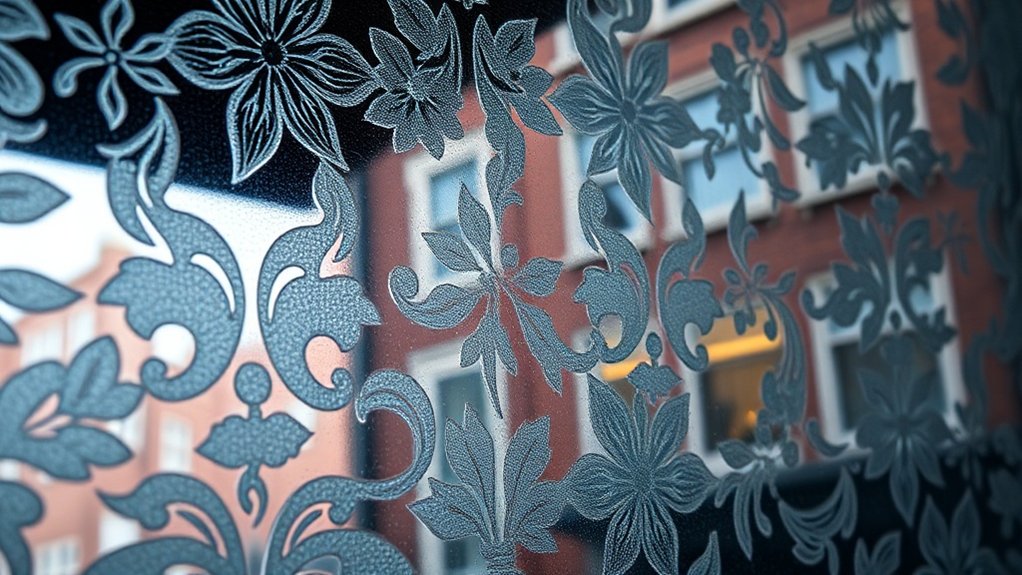
The patterns available in Hendon run from full Victorian ornament, with floral etching, reeded borders and prismatic rounds, through to the plainest contemporary textures such as fine flutes, satin etching and micro-dot gradients. You are deciding between dense historic patterns that scatter light and hide the view, and restrained textures that soften glare while keeping a sense of continuity.
Classic Victorian Glass Patterns
Victorian and Edwardian glass still defines many Hendon streets. The classics are acid-etched florals and borders, deeply rolled reeded glass, geometric prism patterns and bullseye rounds. Each handles light differently, from the soft glow of etching to the sparkle of prisms, and all of them can now be made in toughened or laminated form so they can go into doors and low panels as well as sash windows and fanlights.
Contemporary Minimalist Textures
Contemporary glass in Hendon relies on texture rather than motif. Frosted finishes from acid etching or controlled sandblasting spread daylight evenly and kill glare, which is why they dominate in slim-framed partitions and shower screens. Gradients are the next step: a pane that shifts from frosted at the bottom to clear at the top screens a seated person while opening up the view above. Very shallow ribs, pixel grids and soft prismatic fields bend light without reading as a pattern at all. Lining up the direction of the texture with the way light enters the room gives a Hendon, NW4 interior a clean, current look.
How to Choose Patterned Glass for Privacy and Light
Think of each pane as both a screen and a light source. Match the privacy level you need to a pattern density: small, tight motifs hide silhouettes best, medium patterns show shapes but not detail, and open patterns only soften the view. Then look at how the pattern handles direct sun, since a good texture breaks a beam into scattered light that keeps the room bright without glare.
Orientation matters as well. Vertical flutes and reeds carry light deeper into a room, while organic or radial patterns give a more even glow. Ask for tested light transmission figures and, wherever you can, look at a full-size sample in the actual window before ordering. Where you want fine control, use a patterned outer pane with a clear inner pane in a sealed unit, which also protects the texture from cleaning.
Patterned Glass for Period vs Contemporary Hendon Properties
Hendon's streets mix eras, so the same pattern rarely suits two neighbouring buildings. In period homes, look for glass that references original leaded grids, floral or geometric motifs and the slight irregularity of hand-made glass. For contemporary schemes, choose low-relief textures such as linear ribs, micro-dot or satin finishes that read as clean surfaces while still managing light, glare and sightlines.
Honouring Heritage Detailing
Period detailing in Hendon is not one style but several, and your patterned glass should be matched to the era that frames it.
- Georgian: fine, low-relief reeds or small diamonds that respect slim sash proportions.
- Victorian: deeper embossing, floral or Gothic tracery scaled to door panels and fanlights.
- Edwardian: simpler, bolder motifs with plenty of clear space, in keeping with leaded light grids.
Sleek Patterns For Minimalism
The most disciplined Hendon projects use patterned glass that is barely noticeable: ultra-fine flutes, soft satin etching or micro-dot gradients that act as a veil rather than a feature. Different degrees of frosting can separate circulation from living space while keeping the light continuous. Where a new extension meets an old house, running the same vertical rib or dot pattern across both sets of openings, with the lines aligned to the transoms and mullions, ties the two together.
Custom Patterned Glass and Bespoke Commissions in Hendon, NW4
Stock patterns cover most jobs, but a bespoke commission in Hendon lets you set every variable: the geometry of the pattern, its scale and depth, how opaque it is, its colour and how much light it passes. We work with fabricators who offer embossing, digital ceramic printing, sandblasting and kiln-formed relief to reproduce a logo or a motif from the building's own ironwork in glass. Patterns are lined up with frame modules, mullions and lighting so joints disappear, and a small sample plaque is approved before any full-size panel is made.
Safety, Maintenance and Durability of Patterned Decorative Glass
A pattern does not change the rules on safety. Glass in doors, side panels, windows below 800 mm, bathrooms and balustrades must be toughened or laminated and marked to BS EN 12600, and balustrades must also meet the loadings in BS 6180. Fire-rated locations need a tested system. All of that works with patterned glass if the toughening or laminating is specified at the outset.
For durability, prefer patterns that are part of the glass itself, such as acid etching, ceramic frit or rolled texture, over surface films that scratch and peel. Avoid deep crevices on surfaces that will be touched or splashed, because they trap dirt. Outside, protect the edges, give the frame drainage and use UV-stable interlayers and compatible sealants, so panels shrug off Hendon's rain and traffic grime without delaminating or dulling.
What Patterned Glass Costs in Hendon and How Long It Takes
Price and lead time in Hendon come down to five things: the glass type (annealed, toughened or laminated), the patterning method (rolled, acid-etched, sandblasted, ceramic frit or digital print), panel size and thickness, the fixing system, and site logistics. Stock rolled patterns in standard sizes are the cheapest; bespoke digital prints and fritted façades sit at the top of the range. Allow roughly 2 to 4 weeks for stock rolled patterns and 4 to 8 weeks for custom-etched or printed panels, plus time for a measured survey, drawings and a sample.
Planning and Conservation Rules for Patterned Glass in Hendon, NW4
Because patterned glass changes how a building looks from the street, Hendon planners treat it as part of the external design rather than an interior finish. In most houses, changing the glass in an existing window needs no permission, but in a conservation area with an Article 4 direction, or on a listed building, you will usually need consent. Officers look at pattern scale, how translucent the glass is, how reflective it is and whether it keeps the rhythm of the façade. Applications go better with photographs of the existing glass, a sample of the proposed pattern and a short note on why it suits the period of the house.
See our main specialist glass page for the full range of options in Hendon. Related work we take on includes privacy glass.
Frequently Asked Questions
Can Patterned Decorative Glass Improve Energy Efficiency in Hendon Homes or Offices?
The pattern itself does not insulate, but patterned glass can be built into a double-glazed unit with a low-e coating, argon fill and warm-edge spacer, so a bathroom or door panel performs as well as any other window and meets Approved Document L. The diffusing surface also spreads daylight more evenly, which cuts glare and reduces the need for lights on dull days.
How Does Patterned Glass Affect Acoustic Insulation in Busy Hendon Streets?
On its own, a pattern makes little difference to noise; mass, cavity depth and lamination are what count. Patterned glass can be laminated with an acoustic interlayer or paired with a thicker clear pane in a sealed unit, which is how a street-facing window in Hendon gets both privacy and quiet. Ask the supplier for a tested decibel rating for the complete unit, and make sure the frame seals are as good as the glass.
Is Patterned Glass Compatible With Smart Glass or Switchable Privacy Technologies?
Yes. A switchable PDLC film is laminated between two panes, and one of those panes can be patterned, so you get a textured surface that also turns from clear to frosted at the flick of a switch. The pattern usually goes on the outer face, with the switchable interlayer protected inside. Use low-iron glass to keep the clear state clear, and plan where the busbar and wiring will be hidden in the frame.
Can Existing Plain Glazing Be Retrofitted With Patterned Film Instead of Replacement?
Yes, and for a quick privacy fix on a sound window it is a sensible option. Etched-effect and patterned window films are applied wet to the inside face of the glass and give a convincing frosted or reeded look at a fraction of the cost of new glass. Films do not change the safety rating of the glass, so a door or low panel still needs to be safety glass underneath, and they tend to scratch and lift after some years.
Summary
Patterned decorative glass is not a fussy throwback; in Hendon's mixed streets the right texture, whether crisp reed, fine flute or heritage etching, gives you privacy, glare control and plenty of daylight at the same time. Match the pattern scale, opacity and glass type to the building and you add character as well as comfort. Call us for a free quote, and we will bring samples so you can see the patterns in your own windows.